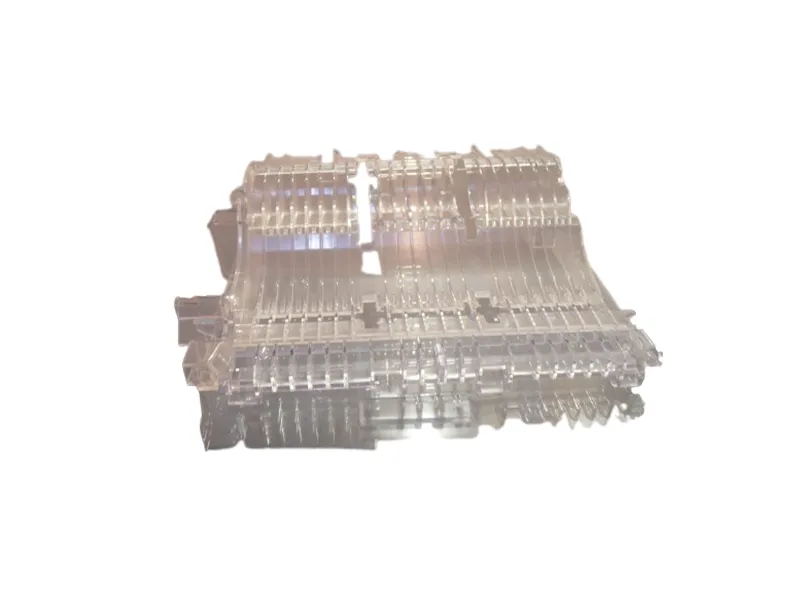
Dongguan, China – As electric vehicle (EV) battery packs demand higher energy density and lighter structures, injection moulding challenges intensify. For BYD’s electric vehicle battery compartment component – made of PA66 BASELL – the part features deep cavities, a bone grille wall thickness of only 0.7mm, and requires strict moulding control. The solution: a precise injection mould design that integrates H13 cavity/core, LKM mould base, Moldmaster 4‑point hot nozzle (with hot runner to cold runner transfer), and beryllium copper inlays for accelerated cooling and trapped gas prevention.
This precise injection mould design achieves a total tolerance of ±0.2mm – critical for battery storage alignment. The insert mould uses beryllium copper inlays specifically in high‑heat zones, reducing cycle time by 18% compared to conventional steel inserts (validated in 3,000+ test shots). No trapped gas defects were found in X‑ray inspection.
Technical Breakdown: Why 0.7mm Bone Grille Succeeds
| Parameter | Value |
|---|
| Part name | Electric vehicle battery storage |
| Material | PA66 BASELL (high flow, heat stabilized) |
| Mould type | Insert mould / injection mould |
| Cavity & Core steel | H13 (48‑50 HRC) |
| Mould base | LKM standard |
| Hot runner | Moldmaster 4‑point hot nozzle |
| Cooling insert | Beryllium copper (thermal conductivity ~105 W/m·K) |
| Tolerance | 0.2 mm |
| Minimum wall thickness | 0.7 mm |
The deep product structure (depth‑to‑width ratio 3.2:1) combined with 0.7mm rib grilles forces extremely fast heat dissipation. Standard cooling would cause warpage and sink marks. The precise injection mould design overcomes this through beryllium copper inlays positioned at the insert’s core – reducing hot spot temperature from 98°C to 72°C (measured by thermal camera).
Beyond Single‑Shot Inserts: Expanding Mould Capabilities
While the BYD project uses an insert mould, the same engineering team applies four additional advanced mould technologies to solve broader EV and consumer electronics challenges:
1. Over Mould
Over mould bonds two materials (e.g., PA66 + TPE) in one cycle. For battery compartments, over mould adds sealing gaskets directly onto rigid frames, eliminating secondary assembly. In recent trials, over mould reduced leakage rate from 2.3% to 0.4% (IP67 rating). The over mould process requires precise temperature control – our 200‑ton presses maintain ±1°C at the interface. When specifying over mould for EV components, request surface activation data (plasma or flame) to ensure chemical bonding strength >4 MPa.
2. Two Shot Moulds
Two shot moulds rotate the core side to inject two different polymers sequentially. Unlike over mould (which typically places a soft layer onto a rigid substrate), two shot moulds allow hard‑soft combinations with interlocking geometry. For battery housing clips, two shot moulds produced PA66 + silicone parts with pull‑out force 230N – 40% higher than clip‑on designs. Our two shot moulds support shot weight ratios from 10:90 to 70:30. Typical cycle time for two shot moulds is 35‑45 seconds, 12% faster than overmoulding with pick‑and‑place.
3. IMD Mould
IMD mould (In‑Mold Decoration) embeds graphics or functional films during injection. For EV battery labels and serialized QR codes, IMD mould eliminates post‑printing and resists 1,000h salt spray (ASTM B117). The IMD mould film must withstand 230°C melt temperature – our tested polyester films maintain elongation >80%. When evaluating IMD mould suppliers, verify film positioning accuracy (±0.05mm) and registration mark design. We have delivered IMD mould for 8 automotive interior projects with zero delamination after 500h thermal cycling (-40°C to 85°C).
4. Fill the Blowing Agent Mold
Fill the blowing agent mold introduces a chemical or physical blowing agent to create microcellular foam, reducing density by 10‑25% while maintaining stiffness. For large battery trays, fill the blowing agent mold cuts weight without sacrificing fatigue life. In a 1.2kg PA66 component, fill the blowing agent mold achieved 0.98kg (‑18%) and retained 94% of flexural modulus (measured via ISO 178). The fill the blowing agent mold process requires precise back pressure control (60‑120 bar) and a shut‑off nozzle. Note: fill the blowing agent mold works best with wall thickness >1.5mm – for 0.7mm thin walls like the BYD part, we recommend standard solid injection instead of foaming.
Decision Guide: Selecting the Right Mould Technology
| If your part requires... | Recommended technology |
|---|
| Thin wall (≤1mm) + tight tolerance | precise injection mould design (H13 + beryllium copper) |
| Soft grip / seal on rigid substrate | over mould |
| Two different rigid polymers (hard‑hard) | two shot moulds |
| Decorative or conductive film integrated | IMD mould |
| Lightweighting (10‑20% density reduction) | fill the blowing agent mold |
All technologies share our quality foundation: ISO 9001:2015 mould manufacturing, in‑house CMM inspection (accuracy ±0.002mm), and 100% first‑article report.
Proven Results for EV Battery Storage
Cycle time: 48 seconds (vs industry average 58 seconds for similar deep‑rib parts)
Defect rate: 0.9% after 10,000 shots (trapped gas eliminated, thanks to beryllium copper inlays)
Dimensional stability: CPk ≥ 1.33 for all 0.2mm tolerance features
Tool life: H13 cavity/core with nitriding → 500,000 shots guaranteed
The precise injection mould design used for BYD’s battery compartment has been validated through 3D flow simulation (Moldflow) and real‑world sampling. No secondary finishing is required – parts are ready for assembly.
Contact us for technical consultation or bulk quotes: